
Category Archives: Uncategorized

Committed

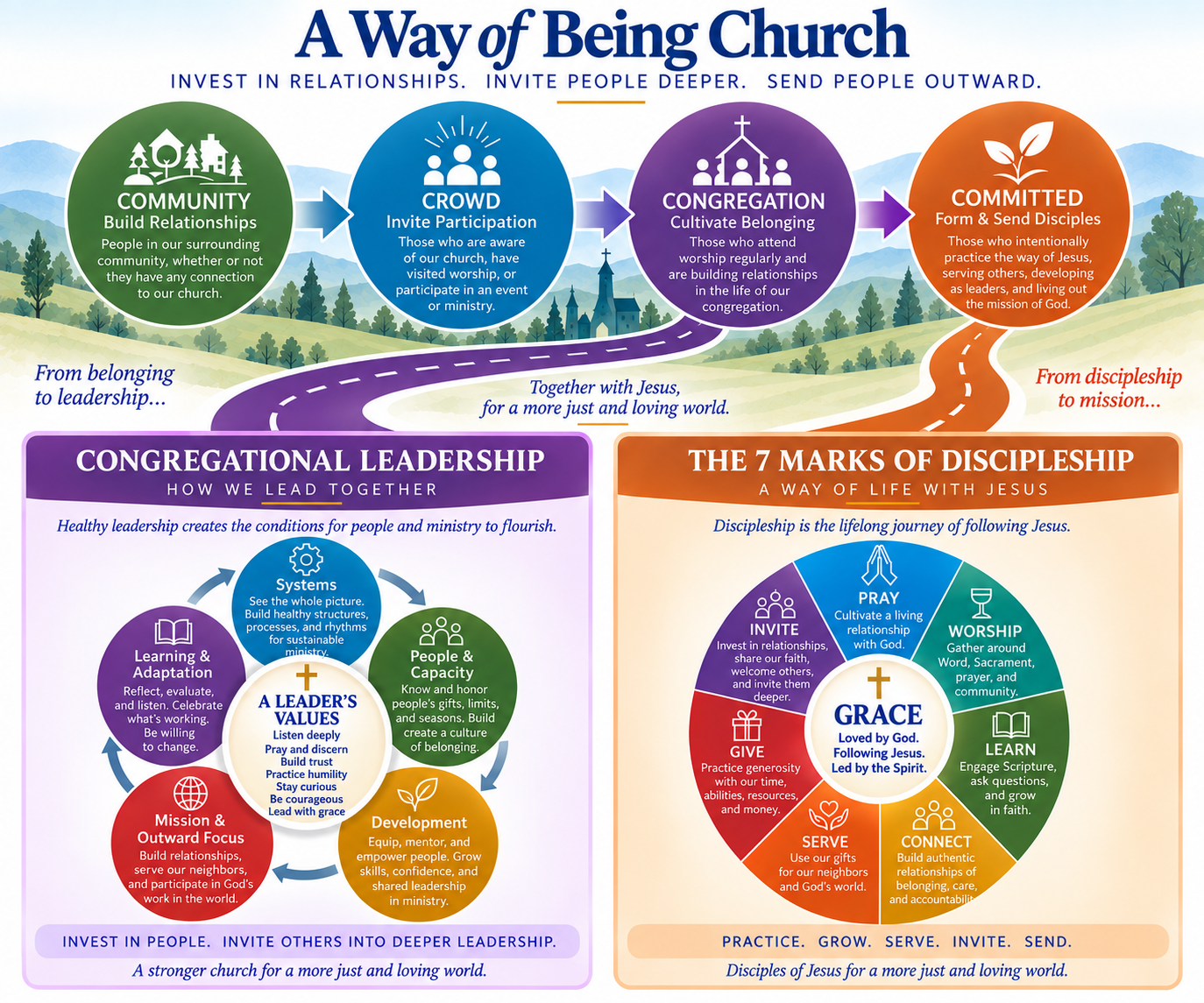
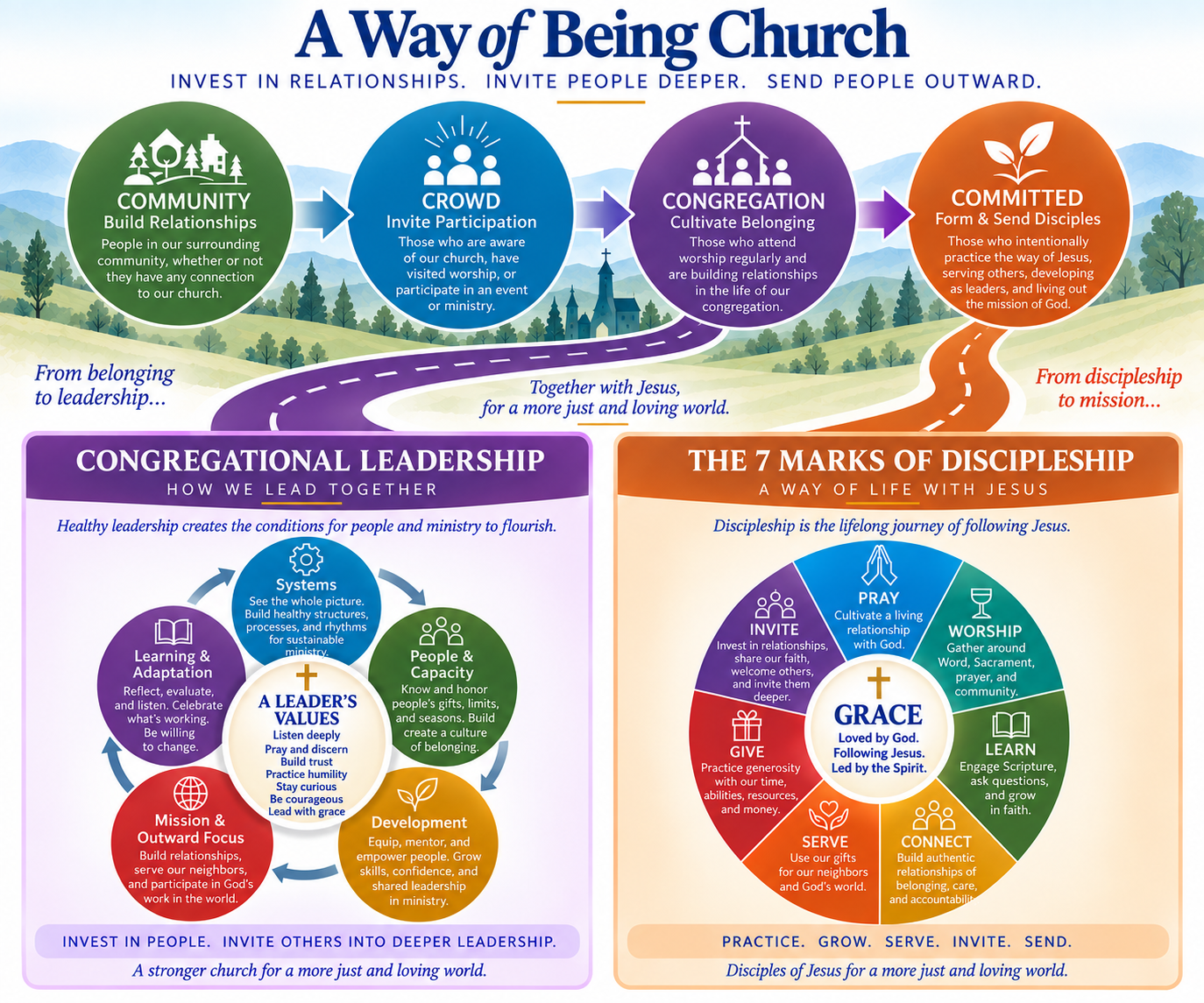
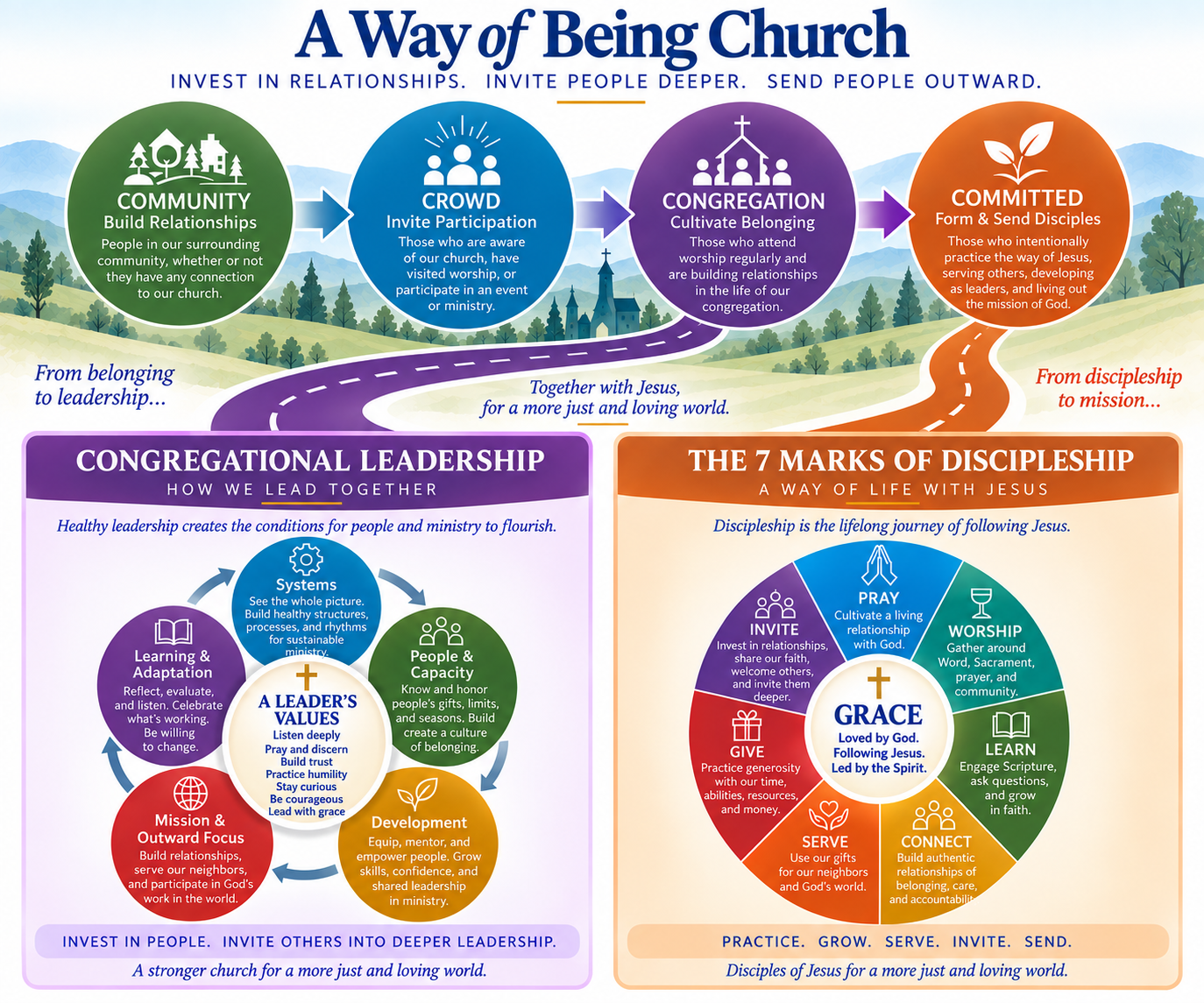
Now we Zoom in to the individual Christian. These folks are committed. They want to follow Jesus and are actively in Christian Community. They are happy to be on the road. What does their faith look like? Michael Foss wrote a great little book on the marks of discipleship and they highly resonate with me.

You can see the image above has personal spirituality like prayer, learning, and giving. Communal spirituality is also there corporate worship, connecting with others, serving the world, and giving.

I believe invitation is important because it brings the individual christian back to the question of who is in the community and crowd, and congregation. The individual Christian as part of the body of Christ is the one who invites people into a deeper relationship with Christ.

Leave a comment

Filed under Uncategorized

Congregation

Rooted in the place it serves, a congregation should constantly be asking: Who is in the crowd? Who is in our community? Who are the people God has placed around us?

The desire of the congregation should be to invite both the crowd and the wider community into deeper relationship with the body of Christ. The congregation is not simply an organization located in a community. It is the body of Christ in that community.

I don’t have all the answers for how to continually make that invitation happen. I don’t think anyone does. But I do know the mission Jesus has given us: make disciples of all nations.

A congregation, then, is a community of disciples of Jesus who are being formed to participate in that mission.

As a pastor, part of my responsibility is to keep that mission in front of the congregation. And to do that well, I have found that I have to think in systems.

Pastors have a unique vantage point in congregational life. We often know what is happening across the congregation in a way that others don’t. We hear about the ministries, programs, relationships, problems, opportunities, and ideas. Sometimes we are simply let in on what is happening; other times we are the ones orchestrating it.

That means I have to step back and look at the whole picture.

How does one ministry connect with another? Where are we duplicating effort? Where are people falling through the cracks? What are we doing simply because we’ve always done it? What practices could be standardized? What needs to be refined? Most importantly, how does all of this serve the mission?

Thinking in systems also means thinking about capacity. What are our people actually capable of doing?

I want to help a congregation stretch, but not break. I want people to grow, but not burn out. Sometimes there may be something that would improve the system, but the congregation simply doesn’t have the capacity to do it yet.

That’s important. Mission is not accomplished by exhausting people.

Instead, part of leadership is developing people so that their capacity grows. We help people see the mission, discover their gifts, develop as disciples, and live out their calling both within the congregation and in the world.

But congregational systems have another problem: over time, they naturally turn inward.

People find their group. Ministries develop their routines. Committees develop their ways of doing things. Relationships deepen, which is good, but eventually the people inside the system can become so comfortable with each other that they stop noticing the people outside of it.

A ministry that once existed to reach people can eventually exist mostly to maintain itself.

That’s why a congregation has to continually recover an outward focus.

Who aren’t we seeing? Who could we invest in? Who could we invite into relationship? Who is standing at the edge of the crowd?And how are we forming the people who are already here to go back out into the world as disciples of Jesus?

This is where systems thinking becomes more than organizational efficiency. The goal isn’t to build a perfectly functioning church machine. The system exists to serve the mission, not the mission to serve the system. And because the mission comes first, no system should be beyond examination.

We have to be willing to reflect on what we’re doing, refine what isn’t working, strengthen what is, and adapt when the community around us changes.

Leave a comment

Filed under Uncategorized

Two Circles – Community & Crowd

Rick Warren in his book The Purpose Driven Church invites us to consider different levels of commitment. He has 5 levels of commitment each within concentric circles: community, crowd, congregation, committed, core. The understanding is that working outward inward are people varying levels of commitment to the church and it’s mission. The invitation is to always move to the next circle of commitment and to recognize where other folks are in their journeys.

I like this image because it helps us to identify how we see ourselves and how we see our neighbors. So, the 4 circles I have borrow from his image: Community, Crowd, Congregation, Committed.

Community – Who is my Neighbor?

The question that I think we should continually ask ourselves is – Who is my nieghbor? When I look at the 10 miles surrounding my church I ask myself? Do they know who my community of faith is? Do they know what we are about? I think this can even go further, but maybe this is more of a denominational level. Does the county, state, country, world know who we are?

In thinking about the Community box I wonder if the goal is just to get our name out there? The congregation I currently serve rents a booth out at the local Art and Wine Faire. We have kids paint rocks we affectionately call “Pet Rocks.” For those of you who are old enough, it is a nod to that 70s trend. But the kids enjoy the activity as their parents sit around drinking wine and hanging out. Getting out our name as a congregation is more than just that. How does the congregation serve the community? And the big question, if that community ceases to be, would anyone notice?

I have no illusions that we are suddenly going to get a ton of people coming to church because we do this Art and Wine Faire booth. I think the more appropriate mindset is just that people would be able to recognize our church when they see it. Sure, I’ve had meaningful conversations and even had one visitor, but I don’t think that is the main goal. I think the main goal is to get our name out there and recognized. This help people who volunteer have appropriate expectations. This where advertisements, social media, newspaper, etc. fit in. Do people in the community know that we exist?

Another part of the community are the people that know we exist and even might know where we are. There are people who come to the church for a variety of reasons. Our church has a movable chancel so we tend to host a lot of recitals. We also host a variety of groups like AA and GA. We host a music school in some of our old Sunday School classes. People may know where we are and even who we are. They may have had contact with us, but that doesn’t mean that they have dived into the waters of a worship service or community event.

We should never image than rubbing elbows in a passive way will bring people into our congregation. It takes investing in relationships and invitation. This circle is about name recognition.

Crowd – Infrequent/Seasonal Contacts

There are people who come to the church for a variety of reasons. There are also folks who come seasonally. I’m thinking about significant holidays like Christmas and Easter. They might come infrequently to congregational events like a potluck or special event that the church is putting on. But you’d rarely see them on church from Sunday to Sunday. They know the church, the ministries, and even people in the congregation, but they can at arm distance for a variety of reasons. I would even put people who would consider themselves members of the congregation because they were confirmed 30 years ago but since they don’t really go to church, they’d still consider themselves members of that church because it’s their family church. They may or may not know the name of the pastor.

I think the goal here should be investing in relationships and inviting them into deeper relationship with the Christ and the congregation.

Leave a comment

Filed under Uncategorized

Welcome Back

It’s been 6 years since I have posted on this site. A lot has happened since then. My hope is to take up the discipline of writing again. I been having a lot of thoughts around leadership, church systems, and discipleship that I want to work through in an public setting. So, welcome back. It’s nice to see you all again.

Leave a comment

Filed under Uncategorized

The Bench in Laramie, WY

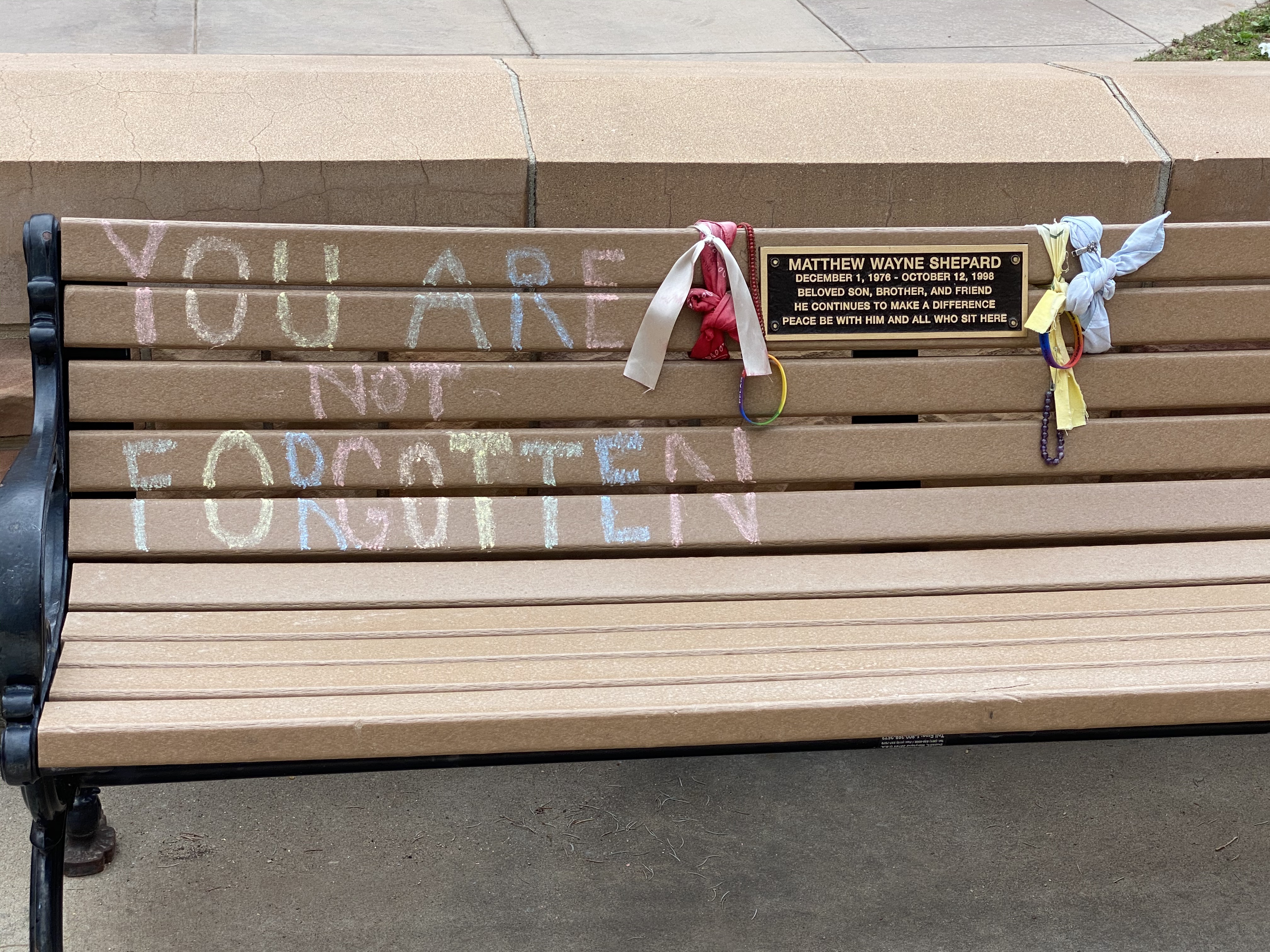
The only places I wanted to see in Laramie, WY were the Matthew Shepard bench (at the University of Wyoming) and the site where he was dumped. Matthew was just 21 years old when he was tortured and left for dead. He later died succumbing to his wounds while in hospital.

Hate killed him that night. One of his attackers had previously expressed anti-gay sentiment and targeted Matthew in a bar.

The place Matthew Shepard was left for dead.

When we arrived at the bench that memorialized him I couldn’t help but think of the trauma he went through before he died. My thoughts moved to his parents losing a child. Selfishly, my mind turned to my two children. “I don’t want my children’s names to end up on a bench,” I said to myself over and over. Tears rolled down my face. Little did I know a bench would evoke in me such an emotional reaction. Even though I was on retreat, I Facetimed my kids from the bench just to tell them I loved them.

People are still beaten and killed, they are still thrown out of their houses, they are still looked at with disgust just for being gay. I used to be a person who thought being gay was immoral. God forgive me.

LGBTQIA+ rights are human rights.

Leave a comment

Filed under Uncategorized

Chapel at Chimayo

It seemed appropriate that my cell phone reception cut out about 30 minutes away from the holy site we intended to visit. We were on a two lane highway coming south from Taos, New Mexico to the Sanctuary at Chimayo. The silence from the 90s Alternative music gave me an opportunity to reflect on those who need healing, the site we were going to was known amongst Native Americans and Catholics for it’s healing dirt. Many people who make the pilgrimage walk from miles away as a sign of their devotion, many carry crosses.
There are many legends about how the Sanctuary at Chimayo was founded. The most popular one is that don Bernardo Abeyta saw a light coming form the ground on one of his fields. He dug there with his bare hands to find a crucifix. He took it to a priest who then carried the crucifix to his own church in Santa Cruz and placed it upon the altar there, only to find that it was missing the next day. It was later found back at the place it was discovered in Chimayo. This happened two more times and it was apparent that the crucifix wanted to reside in Chimayo. Abeyta then asked to build a chapel at that spot believing that the crucifix and land it resided on had healing powers.
When we entered the chapel it was evident the reverence shown by the pilgrims. There were people praying, lighting candles, and venerating the different artwork in the chapel. I passed the altar rails and through a small little doorframe to the left. to come into another room full of crutches, a testimony to those who left them there when they had been healed. Through a smaller door was the dirt room where there was a small hole in the ground said to have been were Abeyta unearthed the crucifix. I thought it appropriate that we had to kneel before it in order to retrieve some dirt.
It’s no wonder people call this the Lourdes of Chimayo. People from all over were there seeking to be healed. In Acts 19:12, Paul is able to heal people from handkerchiefs and aprons that he had touched. So, believing that dirt can heal is not a long stretch in the Christian’s imagination.
I do know a universal truth. We are all looking to be healed from something, whether it be physical, mental, or spiritual. God promises us that through him we will be healed, in this life, or the next. I hold onto those promises as I let the dirt settle into my hands.

Leave a comment

Filed under Uncategorized

A Case for Online Communion: Or, Why My Brother is Wrong!

I didn’t want to write this because we did a whole podcast on it, but my former Professor from Fuller doesn’t think I care about theology (because I quoted Luther’s words to Jeremy in a Facebook thread), so I felt inclined to prove him wrong. Take that Clay.

BTW: You can find the podcast where we beat this dead horse here. 

You can also find my brother’s article here… https://jpserrano.com/2020/04/05/a-case-against-online-communion/

Some Concessions

The Solid Declaration of the Formula of Concord made it clear that outside of the use, there is no Sacrament.  That means if it’s not being used for what it was intended it’s not the Sacrament.  I didn’t come up with this, but you can look it up yourself: Solid Declaration: Article 7, line 85.

So, things like solitary masses, or Eucharistic adoration, ocular reception (can someone say spiritual communion?) is not something that I think Lutherans should be on board with because it is not being used for intended purpose.  It really seems like the Solid Declaration was clear on this, at least to me. 

Don’t get me started on the tradition of “fasting from the table.” To me, asking me to fast is grasping for a tradition to justify being uncomfortable. Talk about emotional reasoning!

Agreement

I agree with my brother and the Solid Declaration that there needs to be some things present in order for the Sacrament to be valid. 

  1. Gathering
  2. Words of Institution
  3. Elements: Wine and Bread
  4. Distribution
  5. Reception

Without these things there is no Sacrament. 

Another Tradition

Why don’t we rely on the tradition of adjusting our practices when there is an emergency? We do this with baptism! Why not with Holy Communion? And I believe that we can do this without straying too far away from the 5 criteria for Communion. 

So here is my suggestions…

  1. Gathering. Yes, we can adjust our conception of gathering. We can gather live online. It’s not as good, but it will do for the time being.  (Caveat: I don’t think recording a service, or watching old communion service is in the spirit of the intention of gathering. It has to be live. I also don’t feel comfortable with mail, drive-by reception, or leaving it out in front of the church for people to receive it.)
  2. Words of Institution. Done, no problem. 
  3. Elements. Well how far do they have to be? Really? Can they be in the same room? Why not just gather the elements together in front of our tables and recognize that whoever is presiding can preside over those elements in front of you?
  4. Distribution. Easy! The pastor says, “This is the body of Christ given for you.” And, “This is the blood of Christ shed for you.” The pastor then gestures for you to receive it. 
  5. Reception: If you are with people you serve each other, if you are along pick them up and consuming them. It’s not as good as someone handing them to you, but again we are operating in emergency times. 

Now, with all of that said I think that once we go back to meeting in person, we abandon the practice…unless another emergency arises and then we do it again.

See things can adjusted slightly and stay within the intention of what Lutherans have held Communion is. 

So Jeremy, you’re wrong.

1 Comment

Filed under Uncategorized

My Problem With Anti-Racism Classes

I have talked before about occupying two worlds here Mixed Race, Tortillas, and #DecolonizeLutheranism so I don’t really feel the need to talk about it again. I will say that I am constantly trying to deal with the white privilege that I have while at the same time being Latino and not always understanding were white folk are coming from.

I’ve also attended more Anti-Racism classes than I can remember.  They have taken many forms whether they be 2 hours, 6 hours, or weekend events with multiple sessions. The programs have looked different with some being more engaging than others.

Anyway, in general, my problem with anti-racism classes are not the classes themselves but that everyone attending are at different places.

For some they need to be convinced that systemic racism and white privilege are  real things.  They want it solely make it about the individual action and intentions that people have. And since they don’t have those they can’t be racists. One reason being shown how it works on a systems level is essential to understanding what People of Color experience on a daily basis.

Others strongly believe that racism is a problem still and understand that systemic racism is prevalent but that somehow they stand outside of that problem.  As if being a white liberal exempts them from having bigotry and prejudice in their own hearts. These folks act as if racism is something that exist purely at a systemic reality and they, being enlightened, exist outside of it. White liberals are racist too.

For People of Color, they are made aware that this space isn’t really for them. At one of the most recent events I went to we are asked was that if we had ever had a Latino in our home. My brother responded, “Every damn day.”  Three of us who are Latino started laughing. That wasn’t a questions that was for us. So, I question what is there for us in these events?

I find myself feeling so awkward in these spaces because I am embarrassed for people. Vulnerability could just be white fragility. Anger could just be unprocessed paralyzing white guilt.

Surely there is another way.  Am I being too critical here?

4 Comments

Filed under Uncategorized

Books I Read in 2016

Helping Children Succeed: What Works and WhyPracticing the Way of Jesus: Life Together in the Kingdom of LoveThe Relational Pastor: Sharing in Christ by Sharing Ourselves


The Children of Light and the Children of Darkness: A Vindication of Democracy and a Critique of Its Traditional DefenseStrength to LoveDaring Greatly: How the Courage to Be Vulnerable Transforms the Way We Live, Love, Parent, and Lead

The Highly Sensitive Person: How to Thrive When the World Overwhelms YouTaco USA: How Mexican Food Conquered AmericaJesus: The Human Face of God (Icons)

Leave a comment

Filed under Uncategorized

Doodles on Divorce

So, here is my time to come out to those of you who don’t know.

I am now divorced.

It’s actually been awhile but I haven’t felt the need to talk about it publicly for a variety of reasons. I have been reflecting on myself and the whole process of divorce and have jotted some stuff down throughout the year. Here it goes…

  • Accept emotional roller coasters.
  • Trust your intuitions about relationships. If something doesn’t feel right, it’s most likely not. It really does take two people for a marriage to work.
  • Realize and try to accept that all issues may not be resolved. Life doesn’t always resolve with tidy bows on them.
  • Forgiveness is a daily practice.
  • Divorce affects more relationships than just you and your spouse. More relationships are affected than you will know.
  • Divorce especially sucks if you liked your spouses family.
  • When people ask, try and talk only about what you did wrong, not what your spouse did.
  • If you can’t say anything nice don’t say anything at all. Sometimes this means being in the same room and not talking.
  • Families tend to rally around their own. It’s natural for family to want to defend their family member and place blame on the other.
  • No matter how much I want to justify myself, I am also to blame.
  • Take one for the team if you have children. This means having to push things aside for the sake of your children.
  • Children suffer the most. They are the ones who have to travel from house to house.
  • Mourning takes a while. Let it.

(Quick Disclaimer: I recognize that every divorce is different. These were notes I wrote to myself and do not mean for them to be universal in their application. I wrote myself these notes to remind myself of my own ideals.)

Leave a comment

Filed under Uncategorized