Tonight I had the honor of speaking at an Interfaith Service of Thanksgiving. I was supposed to talk about interpersonal relationships and family. So this is roughly what I said…
I thought it be fun to center my thoughts about family and relationships with a reading from Matthew 1:18-21
18 Now the birth of Jesus the Messiah[a] took place in this way. When his mother Mary had been engaged to Joseph, but before they lived together, she was found to be pregnant from the Holy Spirit. 19 Her husband Joseph, being a righteous man and unwilling to expose her to public disgrace, planned to divorce her quietly. 20 But just when he had resolved to do this, an angel of the Lord appeared to him in a dream and said, “Joseph, son of David, do not be afraid to take Mary as your wife, for the child conceived in her is from the Holy Spirit. 21 She will bear a son, and you are to name him Jesus, for he will save his people from their sins.
I wanted to read this scripture to you because it shows that family is… complicated. We are about to gather at the thanksgiving table with a bunch of people it can be complicated. If you find yourself in a complicated family, I want to assure you that you are in good company. The holy family knows what it means too.
The second thing I keep think about in these verses is the kindness the Joseph shows Mary. He was going to divorce her quietly. He didn’t want to publicly shame her or have her face the social consequences of being pregnant. So it was kind of him to want to do it quietly.
But then the angel comes and says, “Hey Joseph, in for a penny in for a pound. God is doing something here that you get to be part of.” And he listened and because of his kindness and curiosity helped usher in the Savior of the world.
So I hope this holiday season if you are part of a complicated family or you are sitting across from a complicated family, you show kindness and curiosity. You never know what can happen.
Tag Archives: faith
Congregation
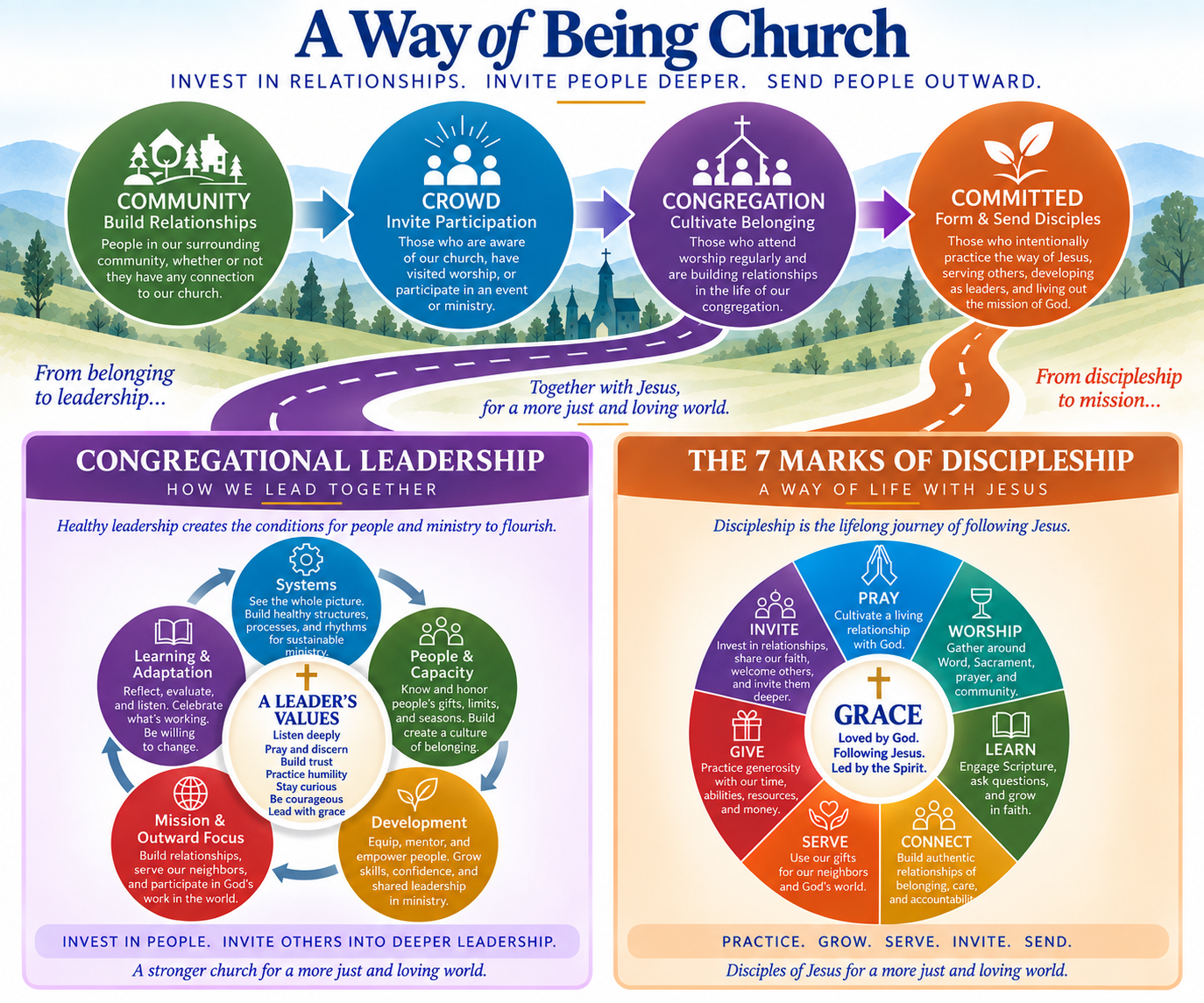
Rooted in the place it serves, a congregation should constantly be asking: Who is in the crowd? Who is in our community? Who are the people God has placed around us?
The desire of the congregation should be to invite both the crowd and the wider community into deeper relationship with the body of Christ. The congregation is not simply an organization located in a community. It is the body of Christ in that community.
I don’t have all the answers for how to continually make that invitation happen. I don’t think anyone does. But I do know the mission Jesus has given us: make disciples of all nations.
A congregation, then, is a community of disciples of Jesus who are being formed to participate in that mission.
As a pastor, part of my responsibility is to keep that mission in front of the congregation. And to do that well, I have found that I have to think in systems.
Pastors have a unique vantage point in congregational life. We often know what is happening across the congregation in a way that others don’t. We hear about the ministries, programs, relationships, problems, opportunities, and ideas. Sometimes we are simply let in on what is happening; other times we are the ones orchestrating it.
That means I have to step back and look at the whole picture.
How does one ministry connect with another? Where are we duplicating effort? Where are people falling through the cracks? What are we doing simply because we’ve always done it? What practices could be standardized? What needs to be refined? Most importantly, how does all of this serve the mission?
Thinking in systems also means thinking about capacity. What are our people actually capable of doing?
I want to help a congregation stretch, but not break. I want people to grow, but not burn out. Sometimes there may be something that would improve the system, but the congregation simply doesn’t have the capacity to do it yet.
That’s important. Mission is not accomplished by exhausting people.
Instead, part of leadership is developing people so that their capacity grows. We help people see the mission, discover their gifts, develop as disciples, and live out their calling both within the congregation and in the world.
But congregational systems have another problem: over time, they naturally turn inward.
People find their group. Ministries develop their routines. Committees develop their ways of doing things. Relationships deepen, which is good, but eventually the people inside the system can become so comfortable with each other that they stop noticing the people outside of it.
A ministry that once existed to reach people can eventually exist mostly to maintain itself.
That’s why a congregation has to continually recover an outward focus.
Who aren’t we seeing? Who could we invest in? Who could we invite into relationship? Who is standing at the edge of the crowd?And how are we forming the people who are already here to go back out into the world as disciples of Jesus?
This is where systems thinking becomes more than organizational efficiency. The goal isn’t to build a perfectly functioning church machine. The system exists to serve the mission, not the mission to serve the system. And because the mission comes first, no system should be beyond examination.
We have to be willing to reflect on what we’re doing, refine what isn’t working, strengthen what is, and adapt when the community around us changes.
Filed under Uncategorized