
Tag Archives: Leadership

Congregation

Rooted in the place it serves, a congregation should constantly be asking: Who is in the crowd? Who is in our community? Who are the people God has placed around us?

The desire of the congregation should be to invite both the crowd and the wider community into deeper relationship with the body of Christ. The congregation is not simply an organization located in a community. It is the body of Christ in that community.

I don’t have all the answers for how to continually make that invitation happen. I don’t think anyone does. But I do know the mission Jesus has given us: make disciples of all nations.

A congregation, then, is a community of disciples of Jesus who are being formed to participate in that mission.

As a pastor, part of my responsibility is to keep that mission in front of the congregation. And to do that well, I have found that I have to think in systems.

Pastors have a unique vantage point in congregational life. We often know what is happening across the congregation in a way that others don’t. We hear about the ministries, programs, relationships, problems, opportunities, and ideas. Sometimes we are simply let in on what is happening; other times we are the ones orchestrating it.

That means I have to step back and look at the whole picture.

How does one ministry connect with another? Where are we duplicating effort? Where are people falling through the cracks? What are we doing simply because we’ve always done it? What practices could be standardized? What needs to be refined? Most importantly, how does all of this serve the mission?

Thinking in systems also means thinking about capacity. What are our people actually capable of doing?

I want to help a congregation stretch, but not break. I want people to grow, but not burn out. Sometimes there may be something that would improve the system, but the congregation simply doesn’t have the capacity to do it yet.

That’s important. Mission is not accomplished by exhausting people.

Instead, part of leadership is developing people so that their capacity grows. We help people see the mission, discover their gifts, develop as disciples, and live out their calling both within the congregation and in the world.

But congregational systems have another problem: over time, they naturally turn inward.

People find their group. Ministries develop their routines. Committees develop their ways of doing things. Relationships deepen, which is good, but eventually the people inside the system can become so comfortable with each other that they stop noticing the people outside of it.

A ministry that once existed to reach people can eventually exist mostly to maintain itself.

That’s why a congregation has to continually recover an outward focus.

Who aren’t we seeing? Who could we invest in? Who could we invite into relationship? Who is standing at the edge of the crowd?And how are we forming the people who are already here to go back out into the world as disciples of Jesus?

This is where systems thinking becomes more than organizational efficiency. The goal isn’t to build a perfectly functioning church machine. The system exists to serve the mission, not the mission to serve the system. And because the mission comes first, no system should be beyond examination.

We have to be willing to reflect on what we’re doing, refine what isn’t working, strengthen what is, and adapt when the community around us changes.
Leave a comment

Filed under Uncategorized

Two Circles – Community & Crowd

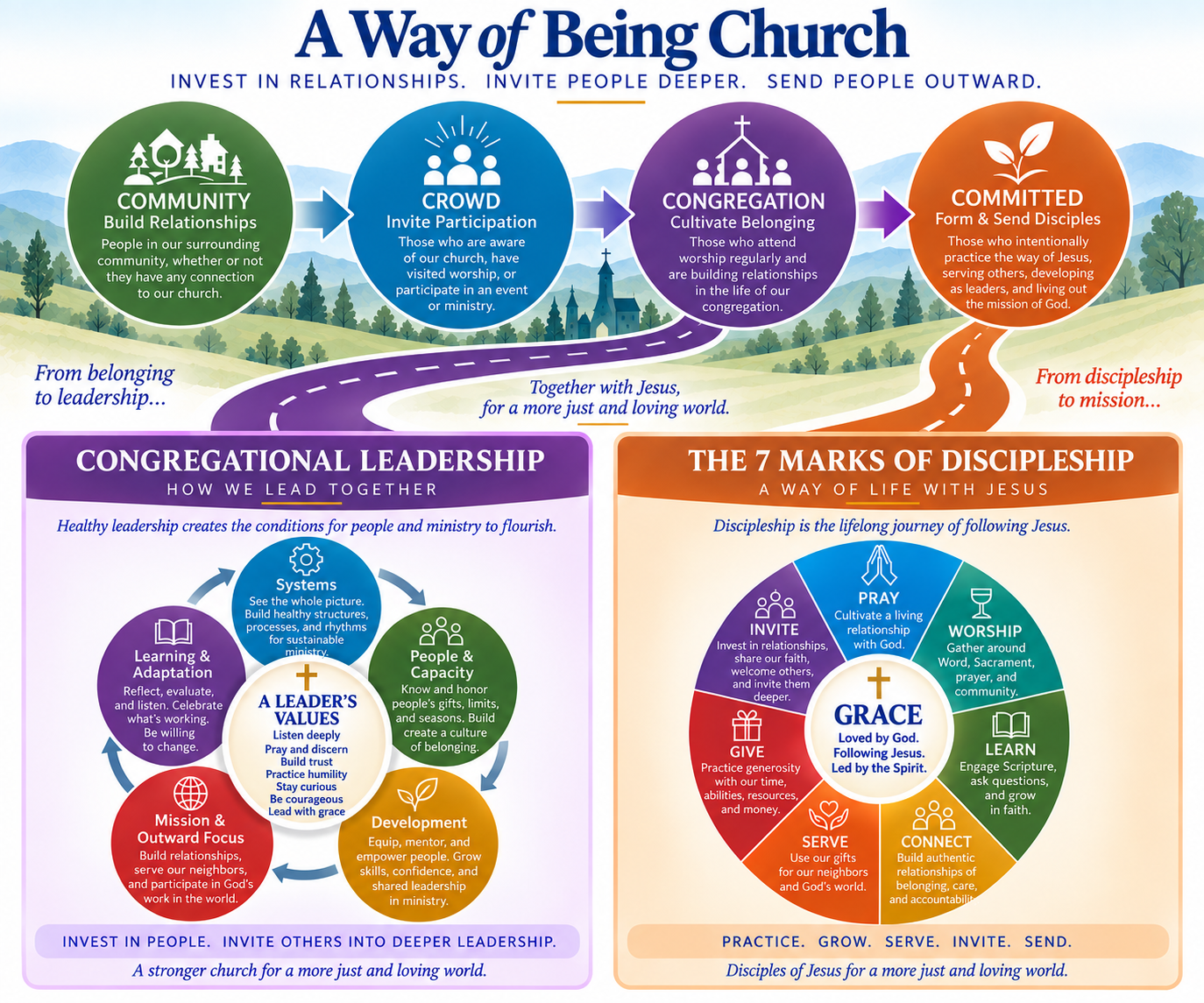
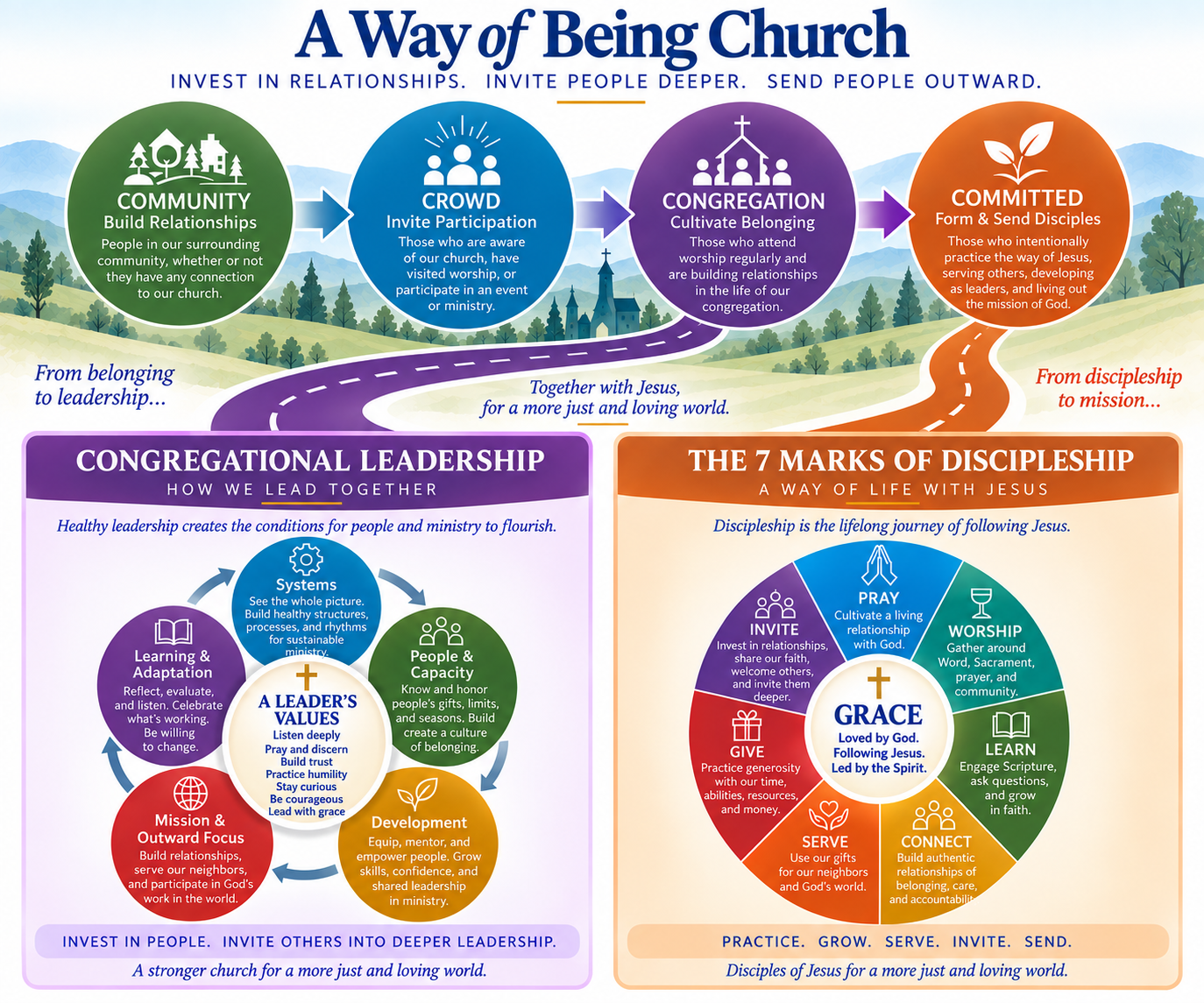
Rick Warren in his book The Purpose Driven Church invites us to consider different levels of commitment. He has 5 levels of commitment each within concentric circles: community, crowd, congregation, committed, core. The understanding is that working outward inward are people varying levels of commitment to the church and it’s mission. The invitation is to always move to the next circle of commitment and to recognize where other folks are in their journeys.

I like this image because it helps us to identify how we see ourselves and how we see our neighbors. So, the 4 circles I have borrow from his image: Community, Crowd, Congregation, Committed.

Community – Who is my Neighbor?

The question that I think we should continually ask ourselves is – Who is my nieghbor? When I look at the 10 miles surrounding my church I ask myself? Do they know who my community of faith is? Do they know what we are about? I think this can even go further, but maybe this is more of a denominational level. Does the county, state, country, world know who we are?

In thinking about the Community box I wonder if the goal is just to get our name out there? The congregation I currently serve rents a booth out at the local Art and Wine Faire. We have kids paint rocks we affectionately call “Pet Rocks.” For those of you who are old enough, it is a nod to that 70s trend. But the kids enjoy the activity as their parents sit around drinking wine and hanging out. Getting out our name as a congregation is more than just that. How does the congregation serve the community? And the big question, if that community ceases to be, would anyone notice?

I have no illusions that we are suddenly going to get a ton of people coming to church because we do this Art and Wine Faire booth. I think the more appropriate mindset is just that people would be able to recognize our church when they see it. Sure, I’ve had meaningful conversations and even had one visitor, but I don’t think that is the main goal. I think the main goal is to get our name out there and recognized. This help people who volunteer have appropriate expectations. This where advertisements, social media, newspaper, etc. fit in. Do people in the community know that we exist?

Another part of the community are the people that know we exist and even might know where we are. There are people who come to the church for a variety of reasons. Our church has a movable chancel so we tend to host a lot of recitals. We also host a variety of groups like AA and GA. We host a music school in some of our old Sunday School classes. People may know where we are and even who we are. They may have had contact with us, but that doesn’t mean that they have dived into the waters of a worship service or community event.

We should never image than rubbing elbows in a passive way will bring people into our congregation. It takes investing in relationships and invitation. This circle is about name recognition.

Crowd – Infrequent/Seasonal Contacts

There are people who come to the church for a variety of reasons. There are also folks who come seasonally. I’m thinking about significant holidays like Christmas and Easter. They might come infrequently to congregational events like a potluck or special event that the church is putting on. But you’d rarely see them on church from Sunday to Sunday. They know the church, the ministries, and even people in the congregation, but they can at arm distance for a variety of reasons. I would even put people who would consider themselves members of the congregation because they were confirmed 30 years ago but since they don’t really go to church, they’d still consider themselves members of that church because it’s their family church. They may or may not know the name of the pastor.

I think the goal here should be investing in relationships and inviting them into deeper relationship with the Christ and the congregation.

Leave a comment

Filed under Uncategorized

Thinking in Images (Introduction)

A while ago I was trying articulate to someone how I think. I told her that I tend to write and think in pictures. When I am writing a sermon I’ll scribble a bunch of fragmented thoughts on the page and then start drawing arrows from one idea to another. Most of the time I haven’t quite figured out how those ideas connect, but somehow I trust that a connection will be made. I’ve been doing it long enough to trust the process

This morning I woke up with an image in my head. I’ve been thinking a lot about how I conceptualize ministry, leadership, and discipleship. Most of the ideas in the image I can’t claim ownership over. It was either a book I read, a conversation I had, or a post I saw on social media. In fact, as I post explanations of the image I’ll share with you where I got an idea from…if I can remember. I do think that as a pastor you have to be a good synthesizer of material.
Luckily with the advent of AI I could have it create the picture that I awoke with. In the coming days, I’d like to sketch out how and why I see things the way I do.

I wonder if you could help me. Read what I’m saying and if you see another way of viewing it, drop it in the comments. I still playing with this image and really think that it could help me at least how I think about ministry.

Leave a comment

Filed under Leadership, Ministry Reflections