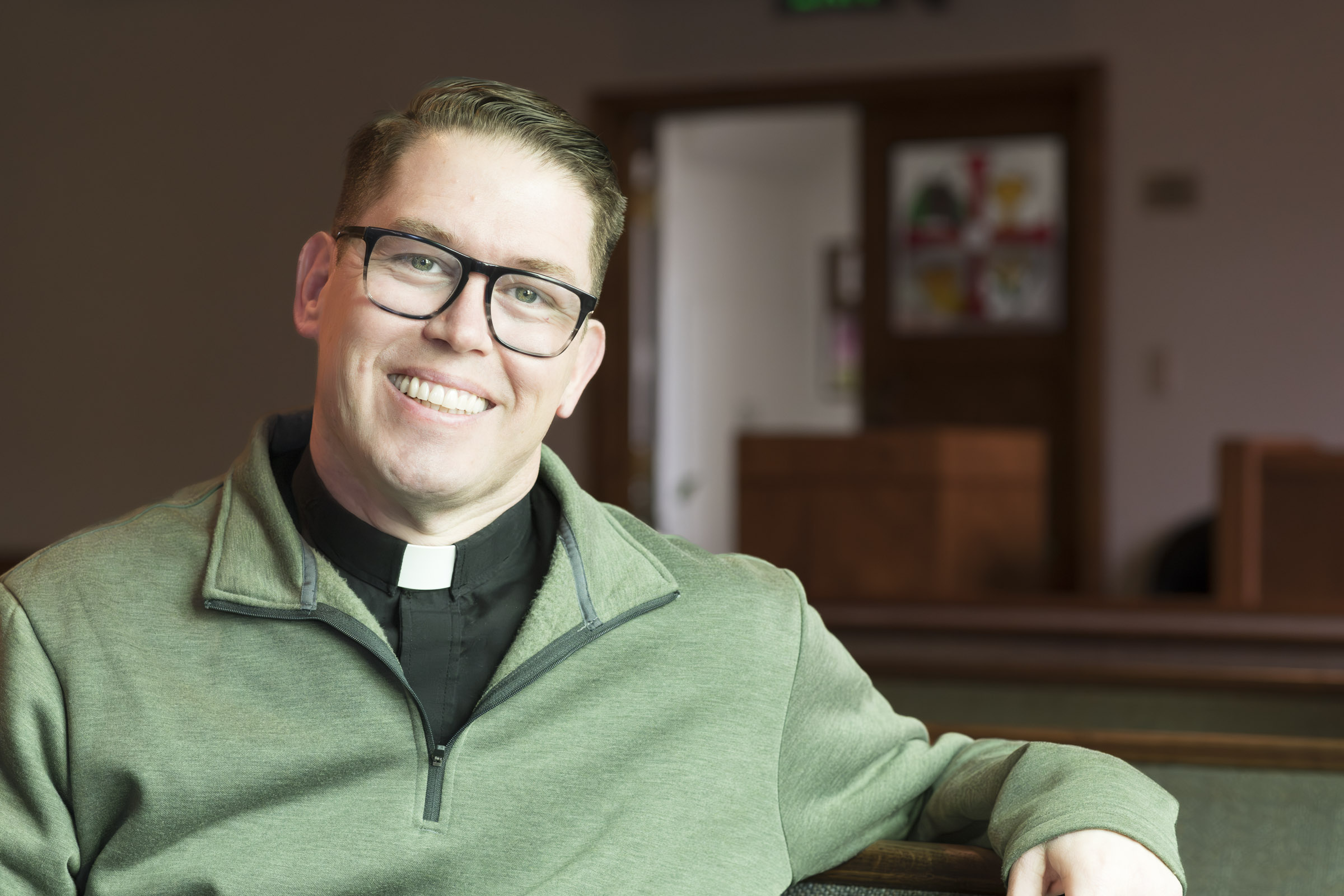
On Waiting

For one of the first times in my life I don’t know what’s going to happen next. Since I was twenty I knew that I wanted to be a pastor. I have known each step I needed to take in order to arrive at this calling has taken years to accomplish.

This path has ended and I now arrive at a fork in the road. Now I wait. Which path I take is mostly not determined by me. I don’t have any control over whether a congregation wants to interview me. I must be invited to interview with a congregation. So, I wait at the fork in the road.

Waiting isn’t easy. It isn’t easy not knowing the next step in my life. And in this waiting I have a bunch of conflicting questions and emotions. Am I going to be called? When is this going to happen? Will it be the right fit? Will my family like it there? I am excited about embarking on a new journey, but also sad that I am leaving my family in San Diego and a wonderful congregation.  All the questions begin to morph into one ultimate question.  Has God brought me this far to abandon me at the fork in the road?  And when I ask this question I immediately know that no is the answer. God does not abandon us.  God has never abandoned us.

This leads me to thinking about Advent. This is the season in our church calender to wait. We wait for Christmas; to remember that Jesus is the Word made flesh that God dwelt among us. It’s during Advent the church especially prays,  “Come Lord Jesus.” We look forward to remembering the birth of Jesus and we also look forward to when Jesus will come again and finish establishing the Kingdom that will have no end. We remember the both now and not yet of the Kingdom of God. It’s during Advent we remember that God didn’t abandon us, but became us.

We all wait for something.  In fact we all spend a lot of time waiting. What happens if we turn waiting into a spiritual discipline? What would happen if during times of waiting we were reminded that God always keeps God’s promises? We can’t do anything about waiting. Nevertheless, while we wait, we could practice being very present in whatever moment we find ourselves. Henri Nouwen once wrote, “For many people, waiting is an awful desert between where they are and where they want to go. And people do not like such a place.”  Waiting is like a desert. I like this quote because it’s the way I feel right now waiting for a call. But I know that it’s in this place of waiting that I can be fully present to God and to others.  I can be fully present because there is nothing that I can do to hasten the object of my waiting.  I can only wait and see the beauty a desert can bestow.

Leave a comment

Filed under Ministry Reflections, Personal

The Sayings of the Desert Fathers

Recently I have been reading The Sayings of the Desert Fathers.  What strikes me about these ascetics is some their profound insight to discipleship. Here is a sampling.

Abba Agathon said, ‘If I could meet a leper, give him my body and take his, I should be very happy.’  That indeed is perfect charity.

Abba Anthony said to Abba Poemen, ‘This is the great work of man: always to take blame for his on sins before God and to expect temptation to his last breath.’

A brother who had sinned was turned out of the church by the priest; Abba Bessarion got up and went with him saying, ‘I, too, am a sinner.’

Leave a comment

Filed under Quotes

Hurt: Time With Adults

I’ve been reading Chap Clark’s book Hurt recently and have been deeply disturbed to learn some of his research.

In his chapter, “Abandonment-the defining issue for contemporary adolescents” he quotes a study found in Patricia Hersch’s A Tribe Apart,

“In all societies since the beginning of time, adolescents have learned   to become adults by observing, imitating and interacting with grown-ups around them,” write Mihaly Csikzenmihalyi and Reed Larson in Being Adolescent. “It is therefore startling how little time [modern] teenagers spend in the company of adults.” In their study Csikzentmihalyi and Larson found that adolescents spent only 4.8 percent of their time with their parents and only 2 percent with adults who where not their parents.

This really shocks me.  My initial gut reaction was this information could not be true.  They are around adults all day: teachers, parents, coaches, etc.  But then I realized that this is mostly time of instruction or receiving tips on how to do a particular activity better. This is not beings-in-relationship.  I then start think about the adolescents in the youth group that I serve.  Many have school until 3pm and extra curricular school activities after such as sports, band, theater, etc.  By the time they get home they have 3 hours worth of homework.  They don’t have the time and parents don’t make the time.

Clark wrote a little earlier in the chapter that many parents take exception to this abandonment.  Many would say that they have sacrificed everything for their children by taking them to and from school, practice, competitions, and concerts. He writes,

This statement is in of itself yet another subtle form of abandonment.  We have evolved to the point where we believe driving is support, being active is love, and providing any and ever opportunity is selfless nurture.  We are a culture that has forgotten how to be together.  We have lost the ability to spend unstructured down time.

His findings definitely ring true.  In reflecting on this book I find that I have to be conscious of this in my own parenting and also that youth ministry is really important.  It shouldn’t be one more thing on an adolescents activity list like soccer or band practice. Youth groups should be a place where they are interacting with an adult(s) in a real and personal way.  A place where they know that no matter what there is an adult who is willing to spend some time with them focusing on them and where they are at in life.

Chap Clark, Hurt (Grand Rapids: Baker Academic, 2005).

Leave a comment

Filed under Ministry Reflections, Parenting, Youth Ministry

Who Holds Our Faith?

I have been thinking a lot about people who do not have the capacity to understand their faith. I think of infants who have not yet developed and the elderly whose brains have started to decay because of Alzheimer’s or Dementia. We baptize the infant and commune the elderly even though their is no recognizable sign that they understand the sacrament that now resides in their bodies unifies them with Christ.

So many times I have visited the elderly who are shells of what they used to be. I know that their brains and bodies are shutting down. Some don’t recognize the wine and bread before them. They relive a conversation with a relative or speak nonsense while we pray together. Sometimes there is a glimmer of recognition when praying the Lord’s Prayer, they repeat it with me and then go back into their own cognitive record skipping, sometimes there is not.

So I’ve been thinking about how my faith is really not held by me. We are too fragile to think that we are capable of being constantly cognizant of being Christ’s Body. Our faith is really held collectively as the body of Christ and therefore God. I wrote in a sermon I gave on the tenth anniversary of 9-11 that I knew that for some people forgiveness is not possible at this point, but that the beauty of community was that when one person in church could not forgive the person sitting next to them was able to. I also wrote that we pray until we ourselves are transformed by the Body of Christ or should I say being conformed to the image of Christ. So when we baptize, commune, or pray with and for people, we as Christ’s Body are holding their faith. We hold their faith because they are me and I am them. The body cannot be separated.

Leave a comment

Filed under Ministry Reflections, Personal